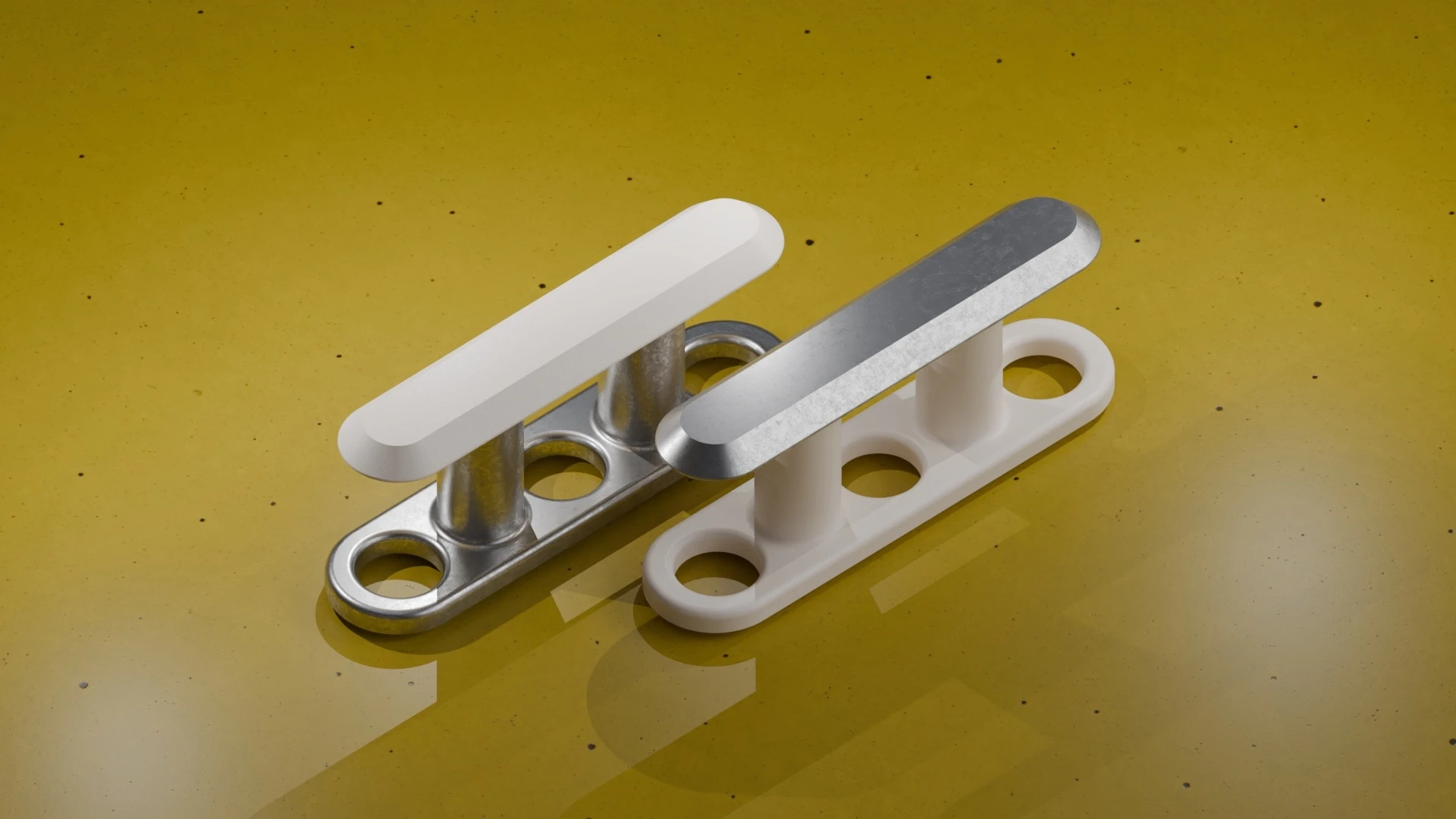
Cleat A 1

Cleat A

Question
How can a utilitarian hardware component be distilled into its simplest symmetrical form while maintaining its structural integrity?
Medium
Industrial Design
Year
2026
Role
Industrial Designer
Skills
Visual Design, Product Strategy, Asset Production

An industrial design study focused on reimagining a yacht cleat as a minimalist, high-precision object using Rhino and Blender.

Details

This project explores the intersection of maritime utility and Apple-inspired minimalism.

By iterating through various textures and materials in Blender, I tested how subtle changes in finish and color affect the visual weight and perceived durability of a standard yacht component.


Process

  1. Defined the design challenge by identifying the yacht cleat as a fundamental maritime element ripe for minimalist refinement
  2. Developed high-precision NURBS geometry in Rhino to establish a symmetrical, plateau-like universal form
  3. Drafted full technical documentation to ensure the design met real-world production specifications and structural requirements
  4. Imported the geometry into Blender to conduct a comprehensive material and texture study
  5. Iterated through various finishes and color combinations to evaluate how surface treatments affect visual weight and perceived durability
  6. Synthesized findings into a design language that bridges rugged maritime utility with high-end consumer electronics aesthetics

A yacht cleat is a humble, purely functional hardware component. What made you choose it as the subject for a high-precision design study?

Cleats are everywhere on a boat—they're the most fundamental piece of hardware because you rely on them to secure the vessel to the pier. I wanted to challenge myself by taking this essential element and stripping it down to its simplest form.

What started as an exercise in refining one object ended up sparking a whole series of new concepts for cleats and hardware mechanisms.

In bringing an Apple-inspired minimalism to maritime hardware, how did you approach the geometry?

It was about finding where symmetry and harmony live in a functional tool. I wanted to discover a 'plateau-like' universal shape—something simple with clean lines and rounded edges that still feels comfortable and usable.

While this specific study focused on a smaller cleat, the underlying form language can adapt, whether that means adjusting top curves for heavier lines or exploring retractable cleats that hide in the side of the hull when not in use.

Your process paired Rhino with Blender. How did those two tools shape the design?

Rhino was where the object was built with high technical precision. I used it to develop the exact NURBS geometry and draft full technical documentation, making sure the design was grounded in real production specs.

Once the geometry was set, I moved into Blender to focus on surface performance, lighting, and tactile qualities.

What did you discover during those material and finish studies in Blender?

I wanted to test how subtle changes in color, finish, and texture affect the object's presence. Marine equipment needs to feel trustworthy, so I evaluated different combinations to see how surface treatments altered the cleat's visual weight and perceived durability—finding the balance between consumer-electronics refinement and rugged maritime hardware.

Looking back at the study, how has this exercise shaped the way you view utilitarian objects?

It proved that even the most basic functional component can be distilled into something pure without losing its structural integrity. Refining a single cleat down to its core geometry didn't just produce a clean final object—it opened up a much wider territory of mechanical ideas and integrated hardware concepts that I'm excited to develop next.

See other projects

WOB

How can we lower the friction of water access to turn individual recreation into a modular social experience?

Aeolus / Yacht Design

How can rigorous hydrodynamic modeling inform the aesthetic soul of a high-performance vessel?